Personal Finance Update: Chapter 4, Tax Changes for 2012

As with every year, 2012 begins with a new set of tax rules, and it’s pretty certain that the tax rules will continue to change throughout 2012.  What makes this a certainty is that Congress did not address some of the tax provisions that expired at the end of 2011.   In addition, while Congress extended the 2 percent cut in the employer’s share of the Social Security payroll tax, the extension only lasts for two months.  There is little doubt that this will be extended for all of 2012, but the Democrats and Republicans will do a great deal of bickering as to how to offset the revenue cost before it is passed.  Finally, the Bush tax cuts will expire at the end of 2012, so they will either have to be extended, or tax brackets will change.

To better understand the changes ushered in in 2012, let’s first look at some of the tax provisions that lapsed at the end of 2011, followed by the highlights for 2012.

I.  Lapsed tax breaks that are likely to be reinstated retroactively for 2012 include:

Write-offs taken for state sales taxes, college tuition and up to $250 of teachers’ classroom supplies.  The higher Alternative Minimum Tax or AMT exemptions and the AMT offset for personal tax credits such as tuition and dependent care.

II.  Lapsed tax breaks that may not be reinstated:

The $500 credit for energy efficient home improvements such as storm windows and water heaters.

III.  Tax Change Highlights for 2012

Personal Taxes:  The tax brackets for 2012 did not change from 2011 owing to the fact that the Bush tax cuts were extended through 2012.

Tax Bracket Married Filing Jointly Single
10% Bracket $0 – $17,400 $0 – $8,700
15% Bracket $17,400 – $70,700 $8,700 – $35,350
25% Bracket $70,700 – $142,700 $35,350 – $85,650
28% Bracket $142,700 – $217,450 $85,650 – $178,650
33% Bracket $217,450 – $388,350 $178,650 – $388,350
35% Bracket Over $388,350 Over $388,350

In addition:

  • The personal and dependency exemption is $3,800 for tax year 2012, up $100 from 2011.
  • The standard deduction for married filing jointly will rise to $11,900 for tax year 2012, if one spouse is age 65 or older, it becomes $13,050, if both are 65 or older, it becomes $14,200.
  • The standard deduction for singles will rise to $5,950 for tax year 2012.  If they are 65 and up they can deduct $7,400.
  • Another big change in the area of personal taxes is the decreased Alternative Minimum Tax or AMT exemption, going from $74,500 to $45,000 for a married couple. Single taxpayers and those filing as Head of Household experience an exemption decrease from $48,450 to $33,750.
  • While credit amounts will continue unchanged for 2012, the Modified Adjusted Gross Income or MAGI threshold at which the lifetime learning education credit begins to phase out rises slightly to $104,000 for joint filers and $52,000 for single filers (up from $102,000 and $51,000, respectively).

Social Security: The Social Security wage base for 2012 rises to $110,100, a $3,300 increase from the 2011 base.  As mentioned earlier, the 2% cut in the employer’s share of the Social Security payroll tax is likely to continue for the entire year after some political “bickering.” Social Security benefits will also go up by 3.6% in 2012, which represents the first rise since 2009.  There are also changes (increases) in the Social Security earnings limits.  Individuals who turn 66 in 2012 can now make up to $38,880 before they hit the earnings limit, but younger retirees (62-65 in 2012) lose $1 from their benefits for each $2 they earn above $14,640. There is no earnings cap once a beneficiary turns 66.

Medicare: For 2012, the Medicare Part B premium will be $99.90 per month, which is up from $96.40 (where it has been since 2008).  However, this represents a reduction for seniors who first enrolled in 2010 or 2011.  As before, for upper income seniors, the part B premium is much higher.  Other changes are listed in the 2012 Medicare & You Handbook.

Retirement Plans: There are also changes made to the retirement savings plans.  For 2012 the maximum 401(k) contribution is $17,000, which represents a $500 increase over the maximum in 2011 (for individuals born before 1963 it is $22,500). The 2012 contribution limits are the same for 403(b) and 457 plans. The contribution limit on SIMPLEs remains at $11,500, and individuals age 50 or older in 2012 can contribute an additional $2,500.

The income ceilings for contributions to Roth IRAs also rise, with contributions phasing out at Adjusted Gross Incomes or AGIs of $173,000 to $183,000 for couples and $110,000 to $125,000 for singles.  In addition, the deduction phase-outs for regular IRAs begin at $92,000 of AGI and is completed at $112,000 for couples and from $58,000 to $68,000 for singles.

Posted in Ch. 4, Tax Planning, Heads Up | Tagged , , , , | Leave a comment

Class Discussion or Assignment: Santana Moss reportedly owes over $250,000 in back taxes

Just because you make a lot of money, doesn’t mean you don’t spend even more.  In Chapter 2 of Turning Money Into Wealth we look at the importance of budgeting and how to actually set up an effective budget – and in Chapter 4 we look at taxes, and let’s face it, you’ve got to pay them.  In Chapter 18 we look at the 12 keys to financial success, and one of those keys is to “Embrace the “B” Word (Budget).”  Unfortunately, it’s awfully easy to ignore this advice and just try to “wing it.”  And, it doesn’t matter how much or how little money you make, without a budget in place, you can run into real problems.

Apparently, that’s what happened to Santana Moss, the 32-year old Washington Redskins wide receiver who was a 2001 first round pick of the New York Jets.  According to a recent Washington Post Insider article, “Santana Moss reportedly owes $258,017 in back taxes,” Santana has a base salary of $2.25 million this season, along with a bonus of $250,000.  He isn’t the only celebrity to experience financial difficulties.  In fact, there is a website that is devoted entirely to Celebrity Bankruptcies – what does all this go to show?  That having money doesn’t mean you won’t experience financial difficulties.

For athletes, the problem seems to be even bigger.  In 2009, Sports Illustrated looked at this problem in their classic article, “How (and Why) Athletes Go Broke.”  Some of their findings were:

  • By the time they have been retired for two years, 78% of former NFL players have gone bankrupt or are under financial stress because of joblessness or divorce.
  • Within five years of retirement, an estimated 60% of former NBA players are broke.

In order to avoid financial problems you have to earn more than you spend, and the only way that happens is if you have a budget.

Class discussion:

  1. Have you set-up a personal budget, if so, what difficulties have you experienced in making it work?  Be prepared to share this with your class.
  2. According to the Sports Illustrated article, “How (and Why) Athletes Go Broke,” where did the athletes go wrong and how do these mistakes relate to the 10 Principles of Personal Finance introduced in Chapter 1?  (This can be assigned as either a short paper to hand in or for discussion in class.).
Posted in Ch. 1, Financial Planning Process, Ch. 2, Measuring Financial Health and Making a Plan, Ch. 4, Tax Planning, Ch.16, Retirement Planning, Ch.18, Financial Life Events | Tagged , , , , , | Leave a comment

Class Discussion and In-Class Introductory Quiz: Your Credit Score

Teaching Tip:  This “quiz” is a great way to begin your lecture on credit scores.  While this exercise can be done online, it can just as easily be done in class, where the correct answer and reasoning behind that answer is presented immediately after your students answer the question.  Of course, if you can project the Internet onto a screen in class – that’s an ideal way to work through this quiz.

As you learn in Chapter 6, Using Credit Cards – The Role of Open Credit, your credit score has an enormous effect on your financial life, influencing everything from the rate you pay on your credit cards, to the size of your credit line, to your insurance rates, to your mortgage rate, to the amount of junk mail you receive asking you to take on one more credit card. In short, when it comes to lending money to you, you will be evaluated by your credit score. With a strong credit score you will also be paying a much lower interest rate on any money you borrow.

So, it makes sense to know what kinds of moves can set your credit score backwards, after all, as you learned in Principle 1: The Best Protection is Knowledge.  Fortunately, to help you make better decisions and to help keep you from sabotaging your credit score, Kiplinger put together an online quiz titled, “Will It Sink Your Credit Score?”  Take a crack at the quiz and see how many questions you get correct.

Discussion questions:

Teaching Tip:  Again, this quiz works great as an in-class presentation when you introduce credit scores.

  1. Which question/answer surprised you the most?  Why?  Be prepared to share your answer with your class.
  2. How many and which questions did you get incorrect?  Be prepared to share your answer with your class.
  3. Do you have any idea what your credit score currently is?  Be prepared to share your answer with your class.
Posted in Ch. 6, Credit Cards, Teaching Tips | Tagged , , , , | Leave a comment

Class Discussion & Podcast: A Financial Advisor Takes a Hit in the Housing Market

Teaching Tip:  This is a fascinating podcast that describes how a financial advisor got sucked into the housing boom and suffered a sad ending.  The podcast isn’t that long, only a bit over 17 minutes, so it isn’t too much to assign.  It can also be played in class.  What makes this such a good podcast is that it lays out in very simple terms how he bought into the housing bubble – it is an excellent podcast for explaining how and why the housing bubble took place and the financial pain that it caused.

In a recent Planet Money podcast, “A Financial Adviser Bets the House,” Carl Richards, a financial advisor and New York Times contributor tells how he got beaten up in the housing collapse.  In Chapter 8 of Turning Money Into Wealth we explore in depth The Home and Automobile Decision including the recent housing bubble.   This podcast and subsequent article takes things to a very personal level, letting you in on the logic that led a very smart financial professional to jump into the housing market at the very worst time.  Mr. Richard’s story is also related in a recent New York Times article, “How a Financial Pro Lost His Home.”

You might yourself thinking about three of the Ten Principles of Personal Finance as you immerse yourself in Mr. Richard’s story.  Principle 1:  The Best Protection is Knowledge; Principle 6:  Waste Not, Want Not – Smart Spending Matters; and Principle 9:  Mind Games and Your Money.

Take a listen to the podcast.  This is just one story of the pain and heartache that the recent housing market bubble caused.

Discussion questions:

  1. One of the changes Mr. Richards mentions is that before his housing tragedy, he focused on the probability of events (for example, very bad financial events) happening.   This has changed, now rather than simply focusing on the probability of an event happening he now focuses on something else, what is that thing?  Why do you think he focuses on it?
  2. What is a short sale?  In his New York Times article, “How a Financial Pro Lost His Home,” Mr. Richards describes how he views the “moral obligation” he had to his bank and the difficulties he had in coming to terms with a short sale.  What do you think of a short sale?
  3. How might any one of the mentioned Principles of Personal Finance made a difference for Carl Richards?
Posted in Ch. 8, Home and Auto, Teaching Tips | Tagged , , , , , | Leave a comment

Finance in the News: A Look at the Principal Financial Well-Being Index

Every quarter the Principal Financial Group has Harris Interactive conduct a survey of the financial well-being of adults working at small and mid-sized U.S. businesses.  So, how do Americans feel about their financial well-being?  The answer can be found in the “The Principal Financial Well-Being Index – Summary 4th Quarter 2011.” 

The results show that the economy, and the uncertainty surrounding it, produces a good deal of stress.  Unfortunately, much of this stress is centered on things that individuals can’t control.  But there are things, even during this time of uncertainty, that you can control and it is important that you focus on what you can control – have a plan to achieve your financial goals, have a sound emergency fund, actively save for your goals, and protect your assets.

What were their top concerns for 2012?

  • Economic uncertainty (62 percent)
  • Gas prices (58 percent)
  • Health care costs (55 percent)
  • Food prices (49 percent)
  • Increased taxes (45 percent)

The survey also reported the top New Year’s resolutions for 2012 made by these working adults.  The top three are:

  • Save a set amount of money each month (26 percent)
  • Work toward paying off credit card debt (26 percent)
  • Reduce spending by a set amount each month (21 percent)

As you look at the top financial concerns, where the respondents felt they had no control, followed by the New Year’s resolutions, where control is totally in the hands of the individual you will come to realize the importance of Principal 2: Nothing Happens Without a Plan as outlined in Personal Finance, Turning Money Into Wealth.  Basically, because it is “easier to spend than it is to save” having a financial plan is having control, the New Year’s Resolutions all revolve around “having a plan”.

Discussion questions:

  1. What are your New Year’s financial resolutions for 2012? (If you don’t have any, you’ll need to come up with some.) Be prepared to share these with your class.
  2. What steps have you taken toward making a financial plan?

Written or discussion assignment:

  1. Take a look at the “The Principal Financial Well-Being Index – Summary 4th Quarter 2011,” what were the top financial blunders that were made in 2011 (note: EE refers to current employees in the tables)?  Did make any of the same mistakes? Which ones?
Posted in Ch. 1, Financial Planning Process, Ch. 2, Measuring Financial Health and Making a Plan, Personal Finance In The News | Tagged , , , | Leave a comment

Personal Finance Video: Understanding the European Debt Crisis

Teaching Tip:  The beginning of the semester is a good time to try to understand what is going on in the economy.  In an earlier blog entry I discussed using a video by The Wall Street Journal to explain the beginning of the financial crisis that started with the downfall of Bear Sterns in 2009, leading to the death of Lehman Brothers, which in turn led to the stock market crash followed by the recent recession. This is very complicated and difficult to simplify and bring down to a level that all students can understand.

This Wall Street Journal three-part video series is titled “The End of Wall Street” and it is an excellent source for helping the students understand this rather complicated topic and keeping their attention along the way.   Each of the videos is about seven to nine minutes long so they provide a short break during the class lecture and at the same time do a great job of explaining these recent events.   I use them in three successive classes.  I play the video in the middle of the lecture and find that this invigorates the class a bit.

With respect to the European debt crisis, The Wall Street Journal recently produced another excellent video, “Europe at the Brink” that helps explain the origins of the European debt crisis.  It takes a look at why and how it spread, and what the threats are to our economy.  This video is about 23 minutes long and does a great job of depicting what has happened and why it is a concern to all of us.  Neither video is particularly uplifting, but they both do a great job of explaining complicated events that will have an impact on all of us.


Posted in Ch.11, Investment Basics, Ch.12, Securities Markets, Ch.13, Investing In Stocks | Tagged , , , | Leave a comment

Class Discussion: Is it time to start saving for retirement?

There isn’t much in the book, Personal Finance, Turning Money into Wealth that doesn’t touch on retirement.  Not only is Chapter 16, Retirement Planning devoted to retirement, much of what we do when we discuss investments in Chapters 11 through 15 is really talking about investing to meet your retirement goals.  Why is that?  That’s because according to the National Endowment for Financial Education survey, “Redefining the American Dream,” saving for retirement is the number one goal for Americans.  Unfortunately, most Americans aren’t making the kind of progress they would like to make.

So, how do you make saving for retirement work?  The answer is to start early, but how early should you start?  That’s an important question, because “when” you start saving for retirement determines “how much” you must save – obviously the earlier you start to save, the less you have to save each year.  In addition, the longer you wait until you retire, the less you have to save each year – and, of course, the higher the rate of return on your retirement investments, the less you have to save each year.  That’s clearly the lesson from Chapter 3, Understanding and Appreciating the Time Value of Money.

The Center for Retirement Research at Boston College recently released a study, “How Much To Save For A Secure Retirement,” that was profiled in the Fox Business article, “Retirement Planning in Your 20s: A Must Do.”  A quick look at the article shows the impact that a 10-year delay in beginning to save has when they examine how much young Americans should save if they start at age 25 or at age 35.

Discussion questions:

  1. Before examining the article, what percent of your pay do you think you would have to save annually in order to retire at 62 if you started at 25?  How about if you started at 35?  How do your numbers change if you want to retire at age 70?  What do you feel you will be able to afford to do?  Take a look at the Fox Business article, “Retirement Planning in Your 20s: A Must Do,” and be prepared to discuss in class your opinions in class.
  2. If you want to save 11% of your income each year for retirement, how would you go about it?  Be prepared to discuss in class.
Posted in Ch. 3, Time Value of Money, Ch.16, Retirement Planning | Tagged , , , | Leave a comment

Class Discussion & Video: Why do we buy so much?

American Public Media’s Market Place recently aired a program titled “The Truth About What We Buy” that dealt with happiness and buying “stuff.”  Much of this story focused on a new book by James Roberts, a professor of marketing at Baylor University, titled “Shiny Objects: Why We Spend Money We Don’t Have in Search of Happiness We Can’t Buy.”

There’s no question we buy and discard more than we need to.  After all, did you know that Americans discard 140 million cell phones every year?  And when it comes to plastic bottles, we discard 2 million plastic bottles, not every day, not every hour, but every five minutes.  Professor Roberts argues that the American Dream now revolves around a desire for fancier clothes, sleeker cars, and larger homes – the Lucky Jeans, bling, Hummers, only the latest version of the iPhone, giant televisions, purebred lapdogs, McMansions, and Abercrombie & Fitch or the “in” clothier of the day.  In his book he not only discusses what motivates you to buy what you do, but he also looks at the relationship between materialism and happiness.

In addition to being a part of the Market Place program, Professor’s Roberts book was also reviewed by The Wall Street Journal in an article titled “Spend It or Save It?”  In contrast this article also takes a look at a book written by Rutgers history professor James Livingston titled “Against Thrift: Why Consumer Culture Is Good for the Economy, the Environment, and Your Soul.”  Interestingly, Professor Livingston’s book was also the focus of a recent story on American Public Media’s Market Place “The Argument Against Thrift.”  Professor Livingston argues that Americans’ efforts to reduce spending in the recent recession have prolonged the recession, and that consumer spending is the key to restarting the economy.

Take a minute and look at Principle 6:  Waste Not, Want Not – Smart Spending Matters and Principle 9: Mind Games and Your Money in the personal finance book “Personal Finance, Turning Money Into Wealth”.  There is clearly more and more evidence that “shopaholics” are among us.  The media bombards us with all of the “must haves” and we can’t turn away.  Behavioral biases can lead to big financial mistakes.  But, rest assured, as you study personal finance you will begin to understand that managing your money involves more than just saving and investing – it also involves spending, specifically smart spending.  It can be done – you can have the things that make you happy and even “help” the economy along as long as you are “smart” about the spending you do to meet your needs while being thoughtful about also protecting your future.

Class Discussion questions (be prepared to share your response with your class):

  1. Have you ever seen an advertisement that has made you want to buy something you didn’t even know you wanted beforehand? What was the item?
  2. In the article “Spend it or Save it?” the author talks about his desire for the world’s most expensive food processor.  Do you have any desires for an “over-the-top” item?  What is it?
  3. What things do you see other people buy to impress others that are excessively expensive?  What do you think of this behavior?
  4. Were you a spender or a saver on Black Friday?
  5. How about on Cyber Monday, were there any deals enticing you to spend?
  6. Do you agree with Livingston? Do you think your spending or saving is helping or hurting the economy?


Posted in 10 Principles of Personal Finance, Ch. 8, Home and Auto | Tagged , , , | Leave a comment

Class Discussion and Assignment: Financial Hurdle #1, Paying for Your College Education

Teaching Tip:  Talking about paying for college generally makes for a spirited class discussion.  This can be done without any reading assignments, or you can assign a reading before class.  There are a number of suggested readings mentioned below.

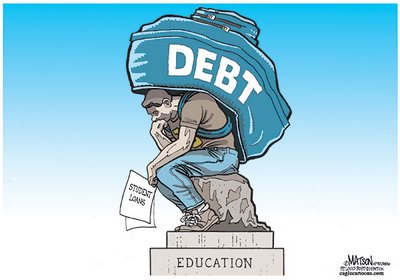
In a recent survey titled “College Funding” conducted by the Institute for College Access & Success, when asked about paying for college, young adults age 18-34 responded “college is both more important than ever and also harder to afford.”   Over three-quarters of the respondents (76%) said that “college has become more difficult to afford over the past five years”, and just under three-quarters of those young adults (73%) felt that “college graduates have more student debt than they can manage.”

Not sure what college is really going to cost? Remember Principle 1: Knowledge is the Best Protection? – it certainly fits here.  Fortunately, there is some potential help – there are now “cost of college” calculators that are available on the college and university websites.  These are commonly referred to as “net price calculators”.  They were mandated by the Higher Education Opportunity Act of 2008 and are now the law of the land.  These calculators focus on the net price that you pay for college after receiving scholarships or need-based grants.  In fact, MarketPlace.org took a look at them in the podcast “New Tools To Calculate The Real Cost Of College.”  It is important to note that it is the “net-price” that you should focus on when trying to determine how much a college will cost.  Why is that?  It’s because about two-thirds of all college students receive grants that cut the cost of college.  So, does this new tool come with a guarantee that it will give you all the answers you need?  Unfortunately, as with most things in the personal finance arena, you’ve got to be wary as Chris Farrell points out in his Marketplace Makin’ Money column, “Net Price Calculators: Be Wary.”

Assignment or Discussion Questions:

  1. Find the net price calculator for your college and use it to determine how much college should cost you (you’ll have to look on your college website).  Was it easy to use?
  2. What concerns are raised in the Chris Farrell column “Net Price Calculators: Be Wary?”
  3. Check out the “Goucher College Net Price Calculator.”  Fill it out, just put in numbers and dates that seem reasonable (the purpose is not to come up with a net price for Goucher) – when you were entering data into the net price calculator, were you surprised at any of the items that go into the calculator’s calculations?
  4. When you applied to college did you have a pretty good idea of what the net price would be?  Have you been surprised by the cost of college?  How have you tried to control costs?  Be prepared to share your response with your class.
Posted in 10 Principles of Personal Finance, Ch. 7, Consumer Loans, Teaching Tips | Tagged , , , , | Leave a comment

Personal Finance in the News, Class Discussion, or Assignment: Who do you believe in the current political debate over who pays what in taxes?

Teaching Tip:  This discussion can be developed based upon an out of class assignment (your students prepare to answer the discussion questions before class), or if you have access to the internet in class and can project it so that the entire class can see the graphs, it works very well as an in class presentation and discussion.

As we know from Principle 4: Taxes Affect Personal Finance Decisions. In the near future it is quite possible that personal tax rates will change quite a bit.  When it comes to changing tax rates, you are likely to hear arguments saying that “the rich don’t pay enough in the way of taxes” countered with “the rich pay more than their fair share”.

In order to develop an educated opinion on this matter there are a number of questions that you might want to ask, including:

Have taxes kept up with wealth accumulation?

Who doesn’t pay federal taxes?

Do rich people pay a lower tax rate?

Who really benefits from tax breaks?

The Washington Post recently took a look at these questions in their Reality Check column article “Answers to Key Questions About Taxes.”  Take a look at the Washington Post’s responses to these questions.  If you’re listening to any of the recent political debates, you’ll notice that a lot of the discussion looks at wealth, personal finance, and fairness in the economy – and these questons are at the heart of much of the debate.

Discussion questions:

  1. Has the tax rate kept up with trends in income (hint: take a look at “Paying a Fair Share?”)?  Do the wealthy pay a smaller or larger percent of their income to taxes now than in past years?
  2. Now look at the reality check “Do Rich People Pay a Lower Tax Rate?”  What share of income goes to the top 20% of those with the highest incomes? Now, what percent of the federal tax burden is paid by the top 20% of those with the highest income? Also take a look at the charts for “Who Doesn’t Pay Federal Taxes.”
  3. What is your opinion on tax reform?  Take a look at some of the tax breaks in the graphs “Who Really Benefits from Tax Breaks?” and the video ”Why Boats Get Tax Breaks.”  Should taxes be raised on the highest income earners?  Why is it so hard for Congress to agree on tax reform.  Be prepared to discuss your opinion with the class.


Posted in 10 Principles of Personal Finance, Ch. 4, Tax Planning, Personal Finance In The News, Teaching Tips | Tagged , , , , , | Leave a comment